Anti-Capitalist Computer Club: High June
ACC here to inject you with your monthly medicine: news about surveillance and tech overreach in Kern County.
First, find out where you can plug in this month.
WHAT’S ON
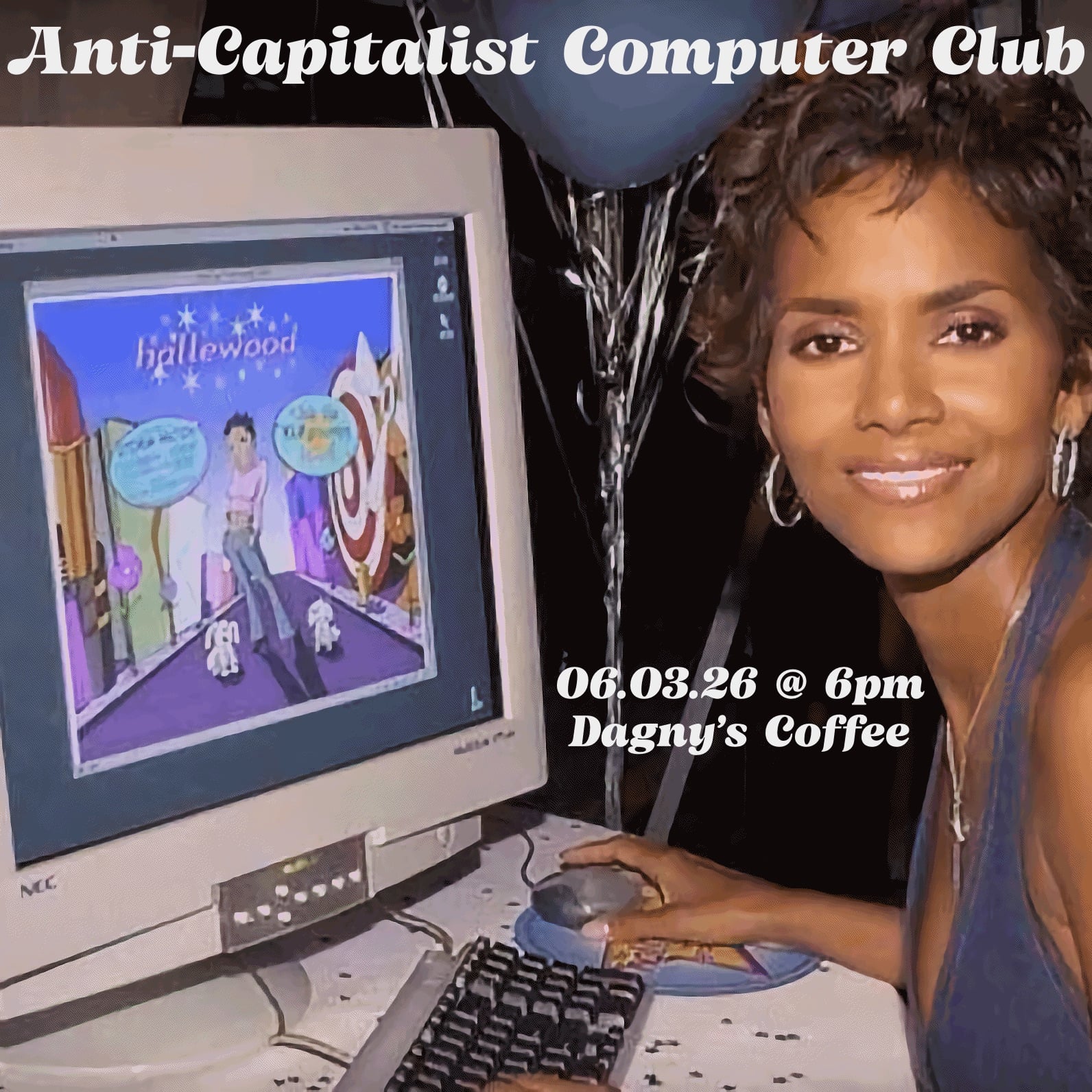
Monthly Meeting / Wednesday, June 3rd 6-8pm at Dagny’s Coffee Co.
This month’s meeting, we’re strategizing for Bakersfield City Council meetings in June. We’ll go over talking points, threat profiling, and contextualize this advocacy by mapping out our asks and how they build on each other.
Bakersfield City Council Meeting / Wednesday, June 10th 5:15pm at City Hall
It’s budget month, y’all! Join us at the hideous funeral home that is Bakersfield City Hall to demand transparency and constituent-driven policies governing surveillance tech in our city. City Council’s draconion conduct rules don’t allow for signage, any sound from the audience, or water bottles. You must pass through a metal detector and endure the presence of law enforcement in full SWAT gear, so consider your risk tolerance before you decide whether or not you’re attending.
Really Really Free Market / Sunday, June 21st 9am-11am at University Park
This market celebrates the one year anniversary of RRFM’s launch. If you haven’t yet experienced the wonderful community that gathers once a month to share free items and services, now’s your chance. We will be tabling as always, offering tech services as mutual aid. Come through to lend your own expertise or to take advantage of ours.
Bakersfield City Council Meeting / Wendesday, June 24th 5:15pm at City Hall
Same shit, different day. We will keep showing up and speaking out.
Flock Walk / Saturday, June 27th 10am-11am at the Valley Plaza Mall Food Court
Help us map the cameras that watch our every move, meet your neighbors, and get a little exercise all at once. Not a bad way to spend your Saturday morning! Keep in mind, we are getting up close and personal with live surveillance cameras at these walks. Consider your personal tolerance for risk and plan accordingly.
BIRD-WATCHING IN BAKERSFIELD
The city sent us two more drops worth of information from our original CPRA request, and there’s a lot to go through. The second batch includes executed contracts going back to the original June 2021 pilot agreement, subsequent amendments, purchase orders, and the department’s official ALPR policy manual. It also includes the city’s formal response letter, in which they denied disclosing camera locations under Government Code §7922.000 and confirmed that no annual ALPR audit reports exist.
Drop 2 is archived and public here.
The third drop is the real data: audit logs from Bakersfield PD’s Flock Safety searches covering October 2021 through February 2026. Individual license plate queries, who ran them, when, all wrapped up in a bunch of CSV files, ready to import into whatever spreadsheet software you use.
We’re working on getting this data into the hands of the Have I Been Flocked team so people in town can find out whether their plate appears in the logs.
The biggest bummer from our request is that the city won’t tell us where the cameras are. Okay. Fine. We’re building the map ourselves anyway.
BirdWatch is our tool for anyone in the Bakersfield area who spots a Flock camera and wants to log it without creating an account on DeFlock or jumping through hoops. Visit that page, tap a button, done. Your GPS coordinates and the time/date go into the database.
We’re using that data to plan our future Flock Walks, filling in gaps and making that sure every camera in the city gets documented on the DeFlock map.
Speaking of… our next Flock Walk will be June 27th at 10am at Valley Plaza Mall. We’ll be meeting up at the food court. Why the mall? Well, the lot surrounding Valley Plaza is lousy with Flock’s ALPRs. Damn near every entrance and exit point is covered.
If you’d rather not drive and get logged in the process, GET routes 22, 41, 42, 44, and 81 all serve the Southwest Transit Center in the mall’s lot off of Wible.
August is a few months away, but it brings the National Week of Action Against ALPRs, organized by DeFlock. Contracts are being cancelled across the country and communities are pushing back on the surveillance infrastructure these private, profit-driven companies have been building out. Sign up at the link above to hear more about how you can get involved there, and hit us up if you’ve got ideas for events you’d like to see ACC plan here in town to line up with this week of action.
DATA CENTER OPPOSITION IN INYOKERN
Meanwhile, in East Kern…
You’ve likely heard at least in passing about energy-draining AI data centers and the small communities fighting back against their development. Now, they’re coming for Kern.
We spoke with Jennifer Slayton, one of the folks organizing the opposition, about what’s going down.
ACC: For folks who may be new to this, can you give a TLDR of the proposed Inyokern data center, what communities it would affect, and why we should care?
JS: A company owned by Robbie Barker of Trona has proposed building a hyperscale, AI-ready data center behind the Chevron in Inyokern. This project includes 40 3MW diesel generators for backup power, so they must obtain permission from the California Energy Commission (CEC) before proceeding with the regular county approval process. The developer is requesting an exemption from a full environmental review process at the CEC under something called a “Small Power Plant Exemption”, which many of us believe is not a legal request. The exemption is for projects that are under 100MW and have “no significant adverse environmental impacts.” However, if you include both phases of this project that he’s promoted to his investors and asked for electric service to serve already, and consider the many adverse environmental impacts of any data center, we firmly believe that it is not appropriate. So we are asking that it be denied and that a full certification be done instead. We are also asking for them to pause any application until the legal process our groundwater usage is caught up in is finished because, legally, projects of this size must show they have enough water for the next 20 years, which obviously cannot be done when we don’t know the outcome of the court battle over our water. We also question the zoning for this, as it is being proposed in an M-2 zone, which requires that things like dust and noise remain within the zone, and, even in his own documents, he states that they will extend beyond that.
Obviously, it would affect Inyokern… it is 370 feet from the closest home to the data center operations, and less than 1400 feet from Inyokern School, and at the two major cross-streets of the community. But in a valley like the Indian Wells Valley, it really affects all of us. Our water, air, and light don’t stop at city or community boundaries, so everyone who lives in this valley has a vested interest in this project and should care. And there are a lot of reasons to care about this… in fact, there are very few reasons not to, unless you just don’t believe the research and data that’s coming out about how serious an impact data centers have on everything from the environment to your utility bills to your health.
But I’ll share the specific reason I care: our groundwater. Our entire valley draws from the Indian Wells Valley Groundwater Basin, a basin that by all accounts is using more water than it’s taking in, and by some accounts using a critically high amount beyond what it takes in. Obviously, this is a problem for our long-term survival, but it’s also a problem for our short-term legality because the state requires that water use be balanced with recharge. As a community, we’ve spent a decade trying to reduce our groundwater usage because the only alternative our local authority in charge of this is pursuing is riddled with challenges and, by some estimates (including my own), would cost every property owner around $3,000 a year on average. Data centers use a lot of water, and could make it impossible to reach this goal without tacking that amount onto my property taxes… and I certainly don’t want to have to pay $3000 a year to have an increase in air and water pollution, higher utility bills, increased strain on infrastructure, our dark skies ruined, and only a handful of actual permanent jobs.
ACC: How did you get involved in this work?
JS: I went to graduate school to study Community Development and community-based Economic Development, and have been working in the Central Valley for the past two and a half decades, so I’ve done a lot of work there for quite a while, while living here in Ridgecrest. I do generally try to avoid getting very involved in community issues where I live because I’m so involved at work, but sometimes there are just things that I think will impact me and my family so much personally, or honestly that are just so infuriating, that I do get involved here as well. The Groundwater Authority and their pipeline was one of those, and the data center coming in the middle of that just took that same fight to the next level for me.
ACC: What’s something that has come up during your work that’s surprised you? Any unlikely friends or foes?
JS: In the community organizing world, there’s a very common saying - no permanent friends, no permanent foes, just permanent interests. I think that’s the thing that always surprises me about working on community issues… the various reasons that folks have for coming to the same conclusion about what they want. And particularly how little that motivation matters to the shared vision we can find and work on together. Beyond that, though… it’s really the enduring relationships that are created when this happens with people we generally would disagree with that I always find surprising and heartening. There’s one particular local resident whom I was adamantly opposed to on a prior issue, and now we’re working closely to try to stop this data center… and I would now consider her my friend - even though I still oppose some of her specific policies and the motivations behind them. Being able to find value in people and not “other” them when we don’t agree with them is not only essential to a civil society, but to the fabric of a rural community. And those threads are forged when we come together and work alongside each other on issues like this.
ACC: There’s this tension coming up in the coverage of this data center and local opposition to it- "We aren’t opposed to innovation, AI is the future, we love AI and use it daily." (My paraphrasing several quotes from residents speaking out, yourself included.) From your perspective, what’s this framing about? Does opposition like this feel like it needs an anti-Luddite disclaimer to be taken seriously?
JS: The “you’re just against progress” argument isn’t a new argument; it’s the same argument the robber barons and the industrial revolution factory builders used for the past couple of hundred years. But one would hope that we’re beyond the exploitative land use and other decisions that led to the horrifying and shameful industrial accidents and human toil that unbridled racing toward “the future” by super-rich guys has also brought throughout history. Even if we appreciate the value technology brings, that doesn’t mean we should blind ourselves to the costs or ignore them when making decisions about how to responsibly account for those in our communities. That’s not to say that there aren’t actually folks who are just adamantly opposed to AI (potentially for very good reasons), or really do fear it (don’t we all at least a little bit?). But I do think the majority of folks claiming we’re attacking the technology itself are being intentionally fallacious because they know they lose on the “smart land use and mitigated negative impacts” argument. And most of the arguments, including those disclaimers, are probably as a result of these fallacious attacks on very real environmental and community concerns.
ACC: Do you have advice for anyone who wants to shape their community for the better through grassroots organizing?
JS: Find something you care about, find other people who care about it, learn everything you can about it, find others who were successful at it, and then follow your passions strategically. A lot of people discount the strategy that’s involved in making change… just showing up to meetings or writing letters is almost never enough. What are the critical paths? What are the levers to change? What’s the strategy to put the pieces in place to make what you think is important happen? And a bunch of caring and committed people working on that is always better in my opinion, no matter how smart or experienced you are. It’s the Margaret Mead quote - Never doubt that a small group of thoughtful, committed citizens can change the world; indeed, it is the only thing that ever has.
ACC: Can you share one clear action item for folks to do right after reading this interview that will help you fight against the development of the RB Inyokern Data Center?
JS: Right now, the one and only thing we need folks to focus on is submitting a comment to the California Energy Commission docket, and then sending that comment as an email to our decision-makers. There’s a pinned post on our Facebook page (if you have that) at Taxpayers for Accountability for Our Groundwater with details on what makes a good comment and where to submit it, and where to send it additionally. If you don’t have access to Facebook, you can just Google “California Energy Commission RB Inyokern data center” and it will come right up (we’d encourage you to also send whatever you comment to local decision makers!).
ACC: You heard it here first folks. We’ve compiled the action items at Inyokern Data Center Info. Solidarity to our neighbors and we will continue to support them in this work.
WHAT WE’RE READING
taken.
Read this for a simple, powerful statement on the data your device gives away without you even knowing (let alone consenting to).
Residents Raise Concerns Over Inyokern Data Center, Ridgecrest Flock Cameras
Okay Ridgecrest, we see you! The reporter of this piece calls the issues of data centers and DeFlock advocacy "unrelated," but are they? Both exemplify the long arm of Big Tech extending into communities without local knowledge or consent, people in power playing with shiny new toys without considering the consequences, and city councils who plug their ears and sing "LA LA LA" whenever people who disagree with them express concerns. But hey, we wouldn’t know anything about that!
Communities are rising up against data centers — and winning
A good reminder that if you feel alone in wanting change for the better, you’re not. The more we connect in this work, the closer we get to the future we want to build together.
The Intersection of Data Center Development, Water Availability, and Environmental Justice in California
A meaty report from nonprofit Next 10 that examines the repercussions of data centers in California’s central valley, and how smaller communities are especially vulnerable to these developments. Of particular interest is the second finding in the Conclusions section (p. 47) on how the impact of water scarcity extends beyond just the cities these are being built in or even near: "Increased demand in one jurisdiction can contribute to basin-wide depletion, reduced drought resilience, and eco-logical stress in distant source regions." The explosion of data center development affects all of us.
WHAT WE’RE LISTENING TO
Pablo Dutta - West Bengal Soundsystem DJ Set
Twenty minutes of DJ Pablo Dutta doing his thing through a Bengali Dek Bass soundsystem. Dek Bass is a DIY sound system culture out of rural West Bengal. The name comes from the cassette decks used to build the setup, and the whole scene grew out of providing sound for weddings and religious gatherings. The utter joy and vibes of everyone jamming out are immaculate.
BYEEEE
See you out there, comrades!