Anti-Capitalist Computer Club: Everything’s Flocked
The Bakersfield Police Department finally responded to our California Public Records Act request about their relationship with Flock Safety, and what they sent us is too important to sit on.
We’ve got the full breakdown of what BPD bought, what it does, and who’s paying for it. We’re also publishing the documents BPD sent us at the end of the newsletter so you can read them for yourself.
After that, we put together a practical guide to locking down your web browser, because reading about a multi-million dollar suburban surveillance network has a way of making you want to do something to cover your ass immediately.
Two things before we get into it:
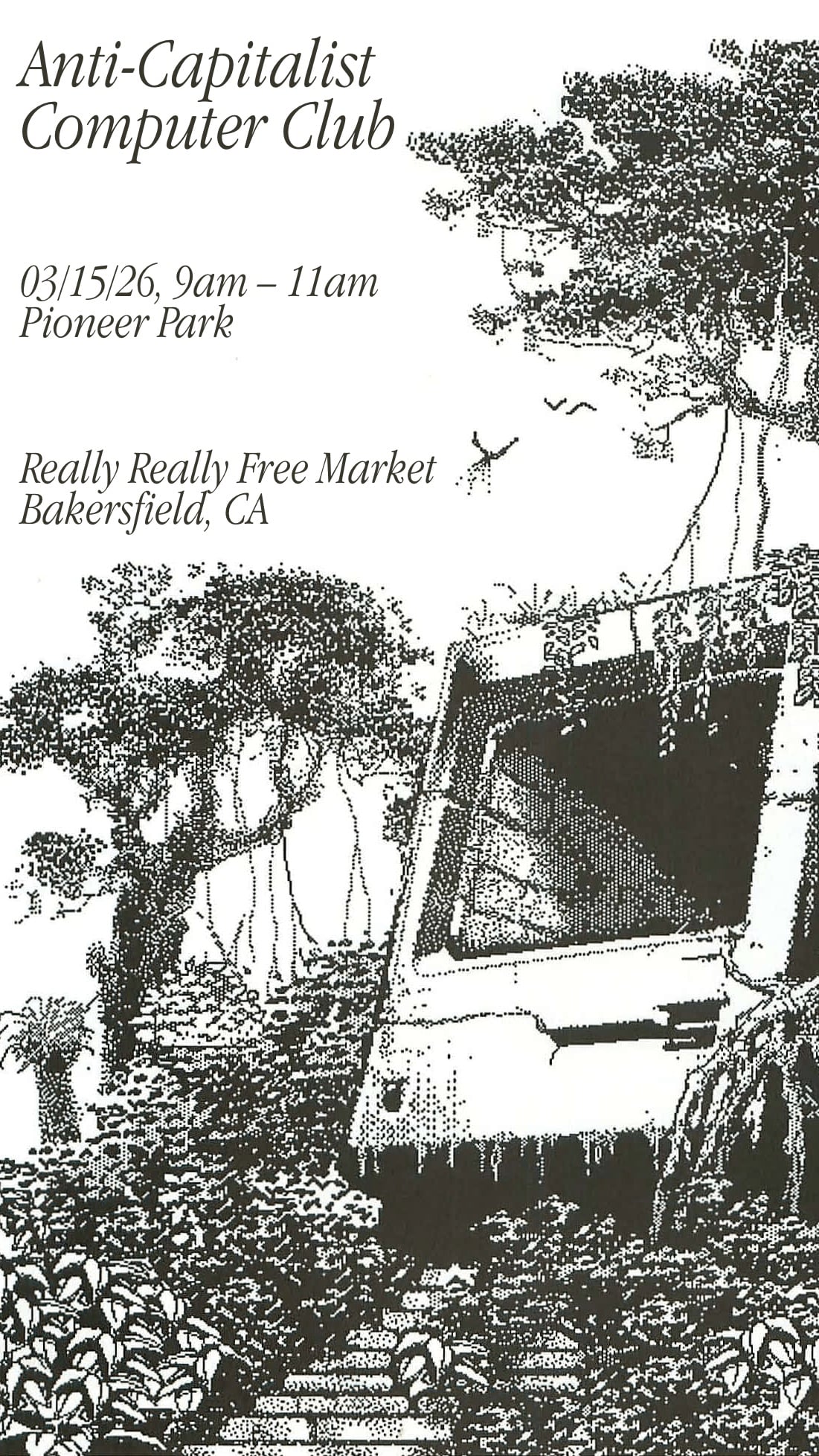
Really Really Free Market — March 15th at Pioneer Park @ 9am. We’ll have our usual table. Bring your old laptop, your phone full of questions, or just yourself. We’d be happy to help you set up the browser extensions covered below.

Next meeting at Dagny’s Coffee Co. — April 1st @ 6pm. No joke. We’ll be there.
BPD’s Multi-Million Dollar Panopticon (And How You’re Paying For It)
We filed a California Public Records Act request with the Bakersfield Police Department. We wanted to see exactly what kind of relationship they have with Flock Safety. If you haven’t heard of them, Flock is the surveillance company quietly building a massive, nationwide network of cameras and license plate readers.
BPD finally got back to us and sent over 13 documents.
This shit is genuinely wild. And we need to talk about it.
The Hardware on Our Streets
As of May 2025, BPD’s Flock Safety deployment includes 133 cameras.
That breaks down to 83 Flock ALPR cameras. ALPR stands for Automatic License Plate Reader — the little boxes that log exactly where your car goes and when. They also have 40 Condor PTZ video cameras, which are full-video, pan-tilt-zoom surveillance cameras. Plus Mobile Security Trailers equipped with even more cameras and sensors.
But 133 is not the number that should concern you the most.
The scariest number here is 128. That’s how many channels each of BPD’s three Wing Video Integration Gateways can accept.
What does that mean in plain English? A Wing is basically a massive hard drive that records network video, packing 64TB of local storage. Those 128 channels can be fed by any compatible camera in the city. We’re talking about traffic cams, feeds from neighboring neighborhoods, and cameras from local schools and businesses.
All of that footage gets piped directly into Flock’s platform. And BPD bought three of these boxes.
What The Software Actually Does
Flock likes to call their platform a "situational awareness operating system." But the contracts gave us the actual feature list they keep off their public sales pages.
Here is what they are doing with all that data:
Convoy Analysis tracks multiple vehicles moving together across the camera network. Read that again. If you and your friends drive to a protest, a mutual aid drop, a church meeting, or just happen to be heading in the same direction, this system can flag that movement and log the connection between your vehicles. This isn’t about catching a specific car involved in a specific crime. This is pattern-of-life surveillance. It maps who you travel with.
FirstTwo Connection integrates a third-party resident database directly into the police map. When cops are looking at an incident, they can click on any nearby building and see the names, ages, and addresses of everyone who lives there. It even links to their phone numbers. They aren’t just looking at the vehicle owner. They’re looking at your neighbors.
Community Camera Registry pulls private and institutional cameras right into the BPD surveillance picture. Fixed camera feeds from local schools, businesses, and neighborhoods, even if those cameras aren’t made by Flock.
Visual Search & Multi Geo Search lets them hunt for vehicles by physical description and query license plates across multiple geographic areas at once. Physical description means exactly what it sounds like. A red SUV missing one hubcap with a roof rack on top. That level of detail. Across every camera in the network, across every zone they have access to.
CAD Connection wires 911 dispatch directly into the surveillance interface, putting calls-for-service and camera footage side by side.
Drone Video Integration pulls live drone feeds right into the same map.
Body Camera Integration lets officers pipe their body-worn camera feeds directly into the platform in real time.
You Are Paying For This
Here is where it gets absolutely infuriating.
A significant chunk of this mass surveillance network is funded by the Board of State and Community Corrections’ Organized Retail Theft Prevention grant. You can read all about the grant program over on the BSCC website.
This is a California state program that was sold to the public as a way to stop shoplifting. Instead, California taxpayers are subsidizing a multi-million dollar surveillance buildout that tracks who you drive with and maps who lives in your house.
BPD is pulling six figures annually from their ORT grant account and from city Technology Services just for the license plate readers. The video camera contract is funded from a totally separate ORT grant account.
In May 2025, Bakersfield signed a consolidation deal pulling every prior Flock contract into a single five-year term. This agreement locks the city into hundreds of thousands of dollars per year through May 2030.
And the document the city signed to govern this massive surveillance relationship doesn’t even have actual rules in it. It just points to a URL for Flock’s Terms of Service. Flock can update those rules whenever they feel like it.
What Comes Next
None of this infrastructure was put to a public vote. Nobody in Bakersfield got a say in whether they wanted convoy tracking, a resident database piped into a police map, or 384 channels of video intake capacity pointed at their neighborhoods. It showed up, paid for with grant money earmarked for shoplifting, and governed by a terms-of-service page that can change without notice.
We are still missing camera locations, privacy policies, and usage audits from BPD. All three were in scope of our original request, but they haven’t produced them yet.
You can bet your ass that we’re going to keep pulling on this thread.
Take Back Your Browser: The Firefox Privacy Starter Pack
So, you’ve read about BPD’s new surveillance network and you’re feeling a little exposed. That’s a reasonable response. We talk a lot about how your life, digital or otherwise, shouldn’t be a product. But fighting surveillance capitalism can feel like trying to boil the ocean.
You gotta start somewhere tho.
And the best place to start is right where you spend most of your time: your web browser. If you’re using Chrome, the first step is to ditch it for Firefox. Google is an ad company. They’re currently making changes to Chrome’s underlying architecture that kneecaps ad blockers.
Now, I’m not going to pretend Mozilla is perfect. They kind of give a shit about your privacy. Mostly, they’re just the only real cross-platform, non-WebKit alternative keeping us from a total browser monoculture. Even if their market share is a fraction of Chrome’s.
The problem is Firefox’s leadership has spent the last few years shoehorning AI features and other revenue-generating crud into the browser. Because of course they have.
So before we even get to extensions, you gotta strip all that junk out. I highly recommend using Just The Browser to handle that. It gives you a clean, basic Firefox install without the bloat.
Once you’ve done that, here are the three essential privacy extensions you need to install.
uBlock Origin
The problem: The modern web is a bloated, tracker-infested nightmare. Every site you visit is trying to load dozens of third-party scripts to track your behavior and serve you ads.
Why it matters: All that garbage slows down your computer, eats your battery, and feeds the massive data-broker machine.
The fix: Install uBlock Origin. Not "uBlock" or "AdBlock Plus." uBlock Origin. It is the absolute gold standard for blocking ads and tracking scripts. It’s lightweight, open-source, and it just works.
While you’re at it, you should soup it up with some custom filter lists. We mentioned a couple in our last dispatch that block AI content farm domains and strip AI features out of sites you already use. Add those. I’d also highly recommend adding the optimized OISD blocklist. It’s basically a massive, curated hit list of domains that serve ads, trackers, and malware.
If you need more motivation: California residents have been filing a wave of class action lawsuits under the California Invasion of Privacy Act (CIPA) against companies that use these exact kinds of trackers on their websites. The courts are starting to take this seriously. The trackers you’re blocking aren’t just annoying. They’re a legal liability for the companies deploying them and a violation of your privacy under state law.
Firefox Multi-Account Containers
The problem: You log into Facebook or Google, and suddenly those companies can track you across every other tab you have open.
Why it matters: These companies build massive behavioral profiles on you by watching what you do outside of their walled gardens.
The fix: Mozilla’s Multi-Account Containers extension. It essentially sandboxes your tabs. You can put all your Google stuff in a "Google" container, and all your social media in a "Social" container. These containerized cookies and trackers can’t escape to follow you around the rest of the web.
ClearURLs
The problem: You ever copy a link to share with a friend, and it has a massive string of random letters and numbers at the end?
Why it matters: That’s a tracking parameter. It tells the site exactly who shared the link, where it was shared, and who clicked on it. It’s how they map out who you might know outside of known social networks without your permission.
The fix: ClearURLs quietly strips all that tracking garbage off the end of your links before the page even loads. It breaks the chain of surveillance without breaking the website you’re trying to visit.
Getting Started
I know it can be a pain to change your daily habits.
But taking control of your privacy doesn’t happen overnight. It’s a process. And locking down your browser is the biggest, easiest step you can take today to opt out of the bullshit.
If you run into any weirdness setting these up, come find us at the Really Really Free Market this Sunday (March 15th) at Pioneer Park. We’d be happy to help you get things sorted.
Things We’re Listening To
"Serious Business" by LOSSES
Paranoid synth music from LA. Seems like a good pick given the rest of this newsletter. 😅 If you like what you hear, they’re playing Jerry’s on March 19th.
"Alligator Bites Never Heal" by Doechii
Funny, biting, sometimes ironic, mostly earnest hip hop album that demands your dull attention while listening. Speaking from experience: great to have in your headphones on your bike commute.
Wrap It Up
We’ll keep posting updates on the BPD Flock situation right here in the newsletter, but we’re also trying to get better about sharing things between issues. We’ve got a Mastodon account where we post shorter updates, links, and commentary as things come up.
A shorter version of the Flock piece above already went up there before this newsletter went out. If you want to stay in the loop without waiting for the next dispatch, the fediverse is the place. No algorithm. No ads. Chronological feed. Honestly, it’s a thing of beauty.
Read The Documents For Yourself
We promised we’d share what BPD sent us. So here it is. These are the 13 documents produced in response to our California Public Records Act request about the city’s relationship with Flock Safety. Contracts, amendments, consolidation agreements, grant funding records, the works.
Download the full set of BPD/Flock Safety CPRA documents (PDF)
Read them. Share them. If you spot a smoking gun that we missed, let us know!